
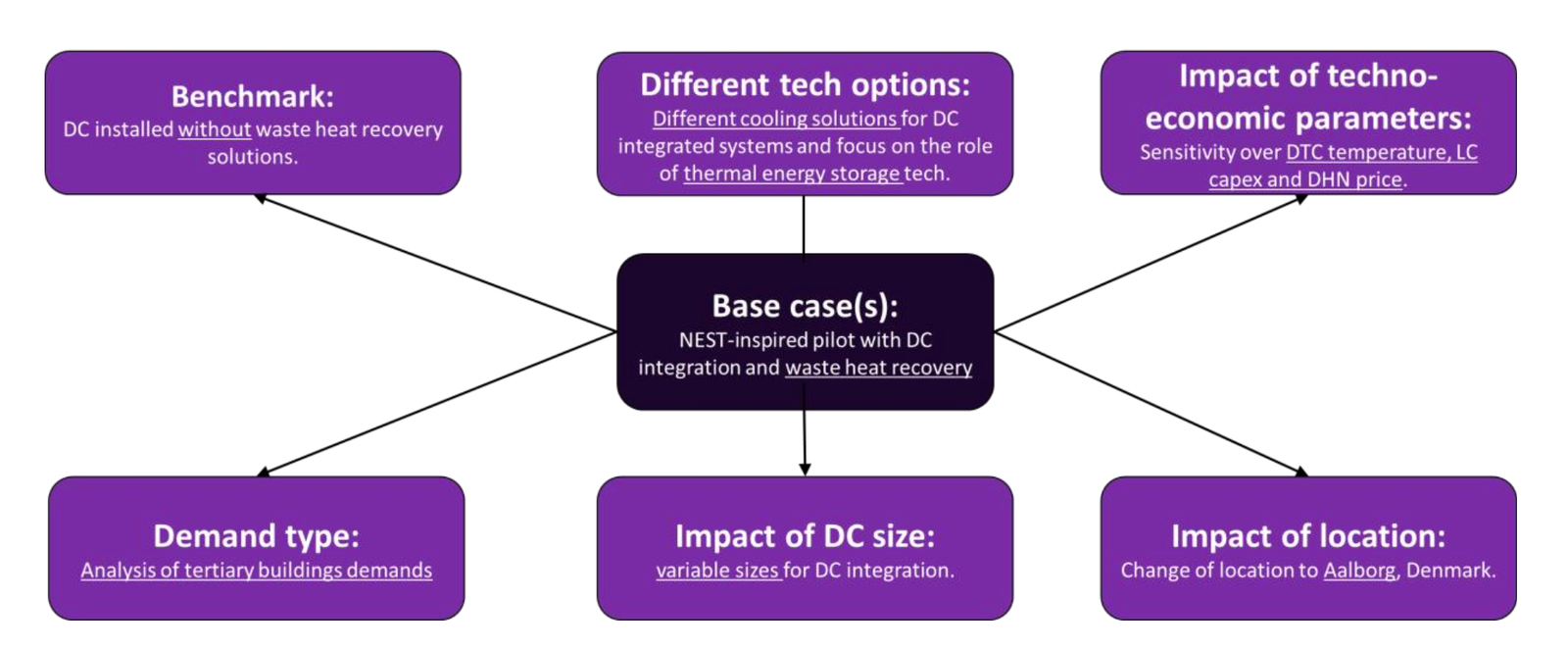
As part of the HEATWISE project, this report evaluates the integration of edge data center (DC) waste heat into tertiary buildings using a mixed-integer linear programming optimization framework. It compares three cooling concepts: standard air cooling with no heat recovery, air cooling with low-temperature recovery upgraded by a heat pump (25°C to 35°C), and direct-to-chip liquid cooling providing high-temperature heat (65°C) for direct network integration. The study assesses these systems over a full year based on total annualized costs, CO₂ emissions, and local climatic influences.
The findings demonstrate that building-scale DC waste heat recovery is highly economically viable, with all recovery configurations outperforming the reference case. Direct-to-chip liquid cooling achieves the best overall performance and shows robust cost-effectiveness even when doubling conservative capital expenditure assumptions. While high-temperature heat is optimal, low-temperature waste heat remains efficient for medium-temperature demands like space heating. Ultimately, system performance depends heavily on matching DC size to building demand, utilizing thermal storage to bridge short-term mismatches, and adapting to local climatic and economic contexts, reinforcing that DC cooling must be designed as an integral component of multi-energy systems.